The TOWN Observatory launched on 10 April 2025 following two years of development by researchers in the Schools of Design and Creative Arts (SDCA) and Architecture, Building and Civil Engineering (ABCE) at Loughborough University. It emerged from the creation of The Impact Hub, a three-year project (2023–2026) established to develop an observatory for Loughborough that monitors change and supports the town’s long-term resilience.
The project, delivered in partnership with Charnwood Borough Council and external consultants, forms part of Healthy and Innovative Loughborough, a £2.46 million initiative led by Loughborough University and funded through the Loughborough Town Deal (2023–2026). The initiative aims to create jobs, support new businesses and improve local health outcomes.
Watch this overview of the Loughborough’s Town Deal programme.
Through the visual presentation of quantitative and qualitative data, the TOWN Observatory promotes urban insight, supports decision making and facilitates dialogue between stakeholders in the town and its surrounding area.
The Observatory focuses on a town level of scale, differing from the metropolitan or regional focus typical of urban observatories worldwide and offering the potential for collaboration with other similar sized locations.
About Loughborough
The Town Deal Investment Plan describes Loughborough as a traditional market town with a population of 67,000, a strong industrial heritage and emerging specialist sectors in pharmaceuticals, life sciences and technological innovation. The town is also home to Loughborough University, consistently ranked among the UK’s top universities and recognised for its strengths in research, sport and technology.
The boundary of the Town Deal is shown in the map below (from the Town Deal Investment Plan, p. 12).
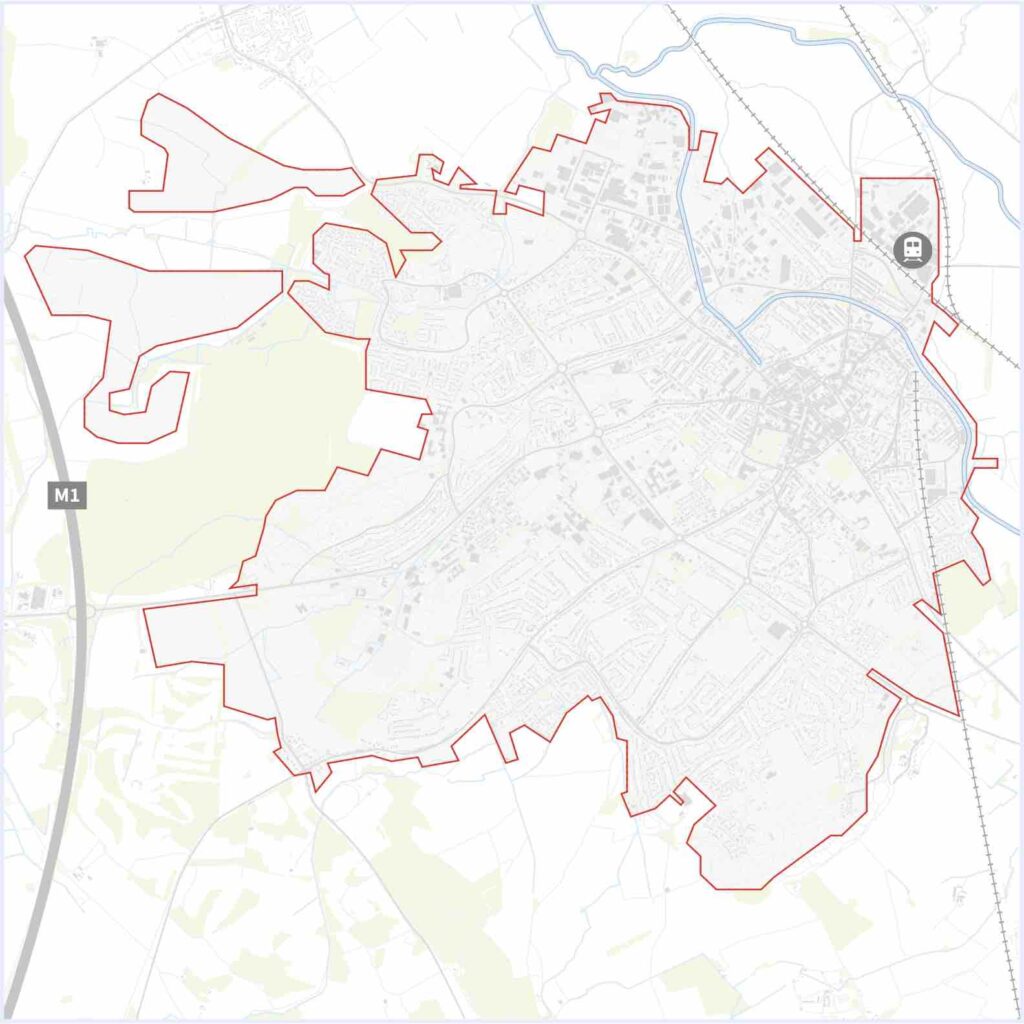
Source: OpenStreetMap © Crown copyright 2021 OS License No. 100023558
+ + +
About TOWN
To describe a town in terms of settlement size places it between a village and a city. Settlements are often described along a continuum of:
Isolated dwelling — Hamlet — Village — Town — City — Conurbation — Megacity.
Defining a town precisely, however, is a challenge. Town environments sit midpoint between the rural and the urban, combining characteristics of both. This blend contributes to their appeal as places to live.
Rural characteristics are often associated with landscape — fields, trees, hedges or open land. Urban characteristics relate to the built environment, including buildings, streets, alleyways, pavements and an infinite variety of public structures that shape a sense of townscape.
The choice of the word ‘town’ in TOWN Observatory reflects the value of working at a scale that is familiar and meaningful to residents. People often relate more readily to places they experience directly — neighbourhoods, villages and towns — than to the wider scale of a city. This emphasis reinforces the human-centred approach of the TOWN Observatory.
+ + +
Funded by the Town Deal in partnership with Charnwood Borough Council.