About the project
Assessing how lighting impacts physical activity and active travel through community perceptions.
Managing lighting of public spaces effectively is a challenge that affects users of roads and green spaces, local councils, law enforcement, and wildlife alike; people need an environment in which they feel safe to be physically active (e.g. cycling, walking, using outdoor gym equipment), while the negative effects on the environment are minimised and the operating funds used efficiently.
Illuminating Loughborough conducts a novel assessment of lighting quality in Loughborough that links a quantitative lighting appraisal with subjective community-based perceptions using innovative digital technology for data collection and analysis, including digital participation platforms. The results will not only advance research but also support the local community, for example through the provision of additional lighting in Southfields Park. The project is integrated in the work conducted as part of the Active Healthy Living and Connected Loughborough projects and includes the collection and publication of community feedback in The Impact Hub’s StoryMaps platform.
Key Activities to date
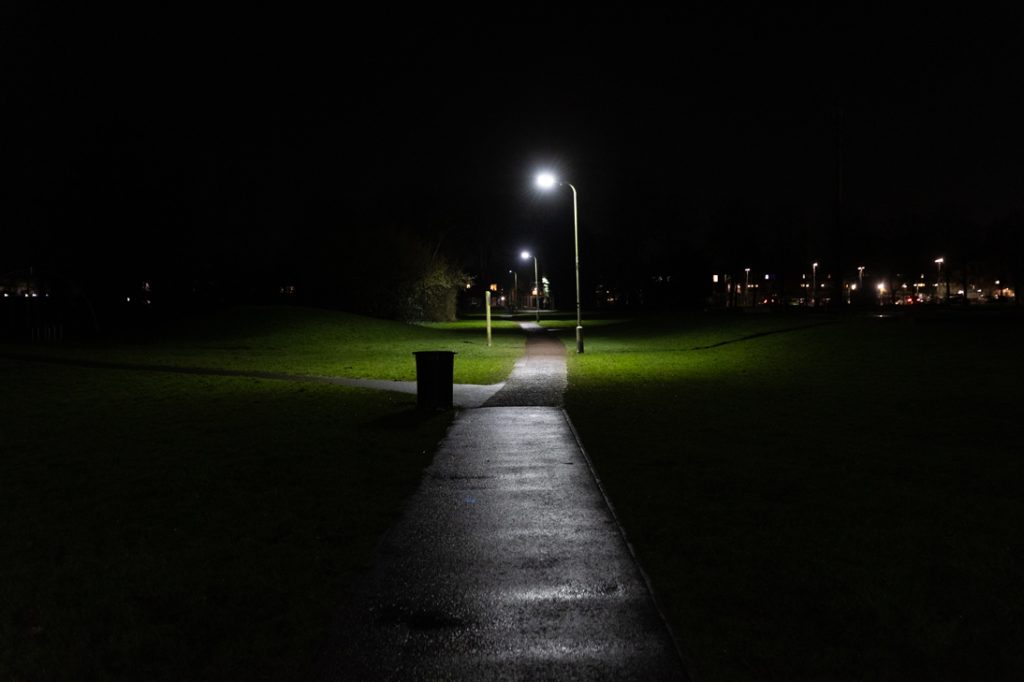
– Infrastructure Enhancements – Significant enhancements were implemented in Loughborough’s Southfields Park, including the installation of solar-powered spotlights, outdoor gym equipment, a series of distance-marked activity tracks, pathway refurbishment and vegetation clearance.
– Community Engagement – Through their involvement in pre‑enhancement community tours, local residents directly influenced the design of the planned future infrastructure enhancements. Post-investment community tours were also conducted to gather resident feedback on satisfaction, perceived safety and accessibility.
– Professional Lighting Assessment – A baseline evaluation of Southfields Park was undertaken by Nick Smith Associates (with support from Thorn Lighting) which helped design and implement the installation of solar-powered spotlights. A post-intervention evaluation, also by Nick Smith Associates, assessed the effectiveness of lighting improvements, noting the potential benefits for wayfinding and recommending further interventions to enhance perceptions of safety.
– Methodological Innovation – The project employed Our Voice method through Stanford University’s Discovery Tool, integrating geo-tagged photos, environmental assessment, and narratives for participatory data collection, promoting citizen science. A novel pre-to-post comparison approach was pioneered, influencing Stanford to update the Discovery Tool interface for improved data coherence.
– Knowledge Dissemination – Preliminary findings were presented at major conferences, including the Royal Geographical Society Annual Conference and the Leicestershire Health Inequalities Conference. Outcomes were also shared via Charnwood Borough Council’s website and social media and presented to representatives of Leicestershire County Council.
– Technology Integration – A draft ArcGIS StoryMap is being developed and quality-assured to embed baseline and post-investment data into the Loughborough Stories StoryMaps platform.
– International Collaboration – Initial discussions to explore a potential international partnership focused on AI-based analysis of geo-tagged photo data collected by local residents focusing on effectively identifying environmental features that promote physical activity engagement.
– Future Planning – A follow-on funding application to the NIHR (National Institute for Health and care Research) Public Health Research (PHR) programme is in preparation, aiming to scale the project across the wider Loughborough area. Also, rationale for future additional enhancements of Southfields Park (e.g. floodlighting at the planned multi-sport Cruyff Court) are likely to be a result of the improved community perceptions following the initial upgrades delivered through the project.
Impact Summary
The Illuminating Loughborough project has delivered significant outcomes across multiple domains. Social impacts include improved lighting, pathways, and vegetation clearance, enhancing safety and accessibility while encouraging greater use of Southfields Park. In addition to this, outdoor gym equipment and a series of distance-marked activity tracks promoted physical activity, and participatory feedback mechanisms fostered inclusivity and ownership. Public engagement extended beyond the park, with outcomes shared through Charnwood Borough Council’s website and social media.
Interventions maintained environmental impact by improving visibility without disrupting biodiversity. The project introduced technological innovations, including interactive digital mapping via ArcGIS StoryMaps (Loughborough Stories), pioneering the Our Voice method through Stanford University’s Our Voice Discovery Tool, and initiating international discussions for AI-based image analysis. These advancements influenced global best practices, including updates to Stanford’s app interface.
Evidence informed policy and planning impact, shaping local investment decisions, supporting a follow-on NIHR funding application, and demonstrating a scalable model for community-led urban planning. Academic contributions include methodological advancements presented at conferences and forthcoming inclusion in a Stanford University-led textbook, ensuring global dissemination. Finally, economic benefits were achieved by optimising public spending and laying the groundwork for long-term health savings through increased physical activity.
This project and other related Town Deal initiatives have improved perceptions of Southfields Park, strengthening the case for funding future developments, such as the planned Cruyff Court, by positioning them within a coherent wider programme. The project also provided strong evidence for enhanced floodlighting which the new multi-use court will provide, with the professional assessment undertaken indicating that more functional lighting would be needed to support greater and safer park use.
Project team and roles
Hans-Heinrich Schumann (Co-Lead Investigator, Research Associate, Loughborough University)
Paul Lester (Co-Lead Investigator, Research Associate, Loughborough University)
Nic Winter (Co-Investigator, Head of Application & Product – Road, Street & Tunnel, Thorn Lighting)
Prof Fehmidah Munir (Co-Investigator, Professor of Health Psychology, Loughborough University)