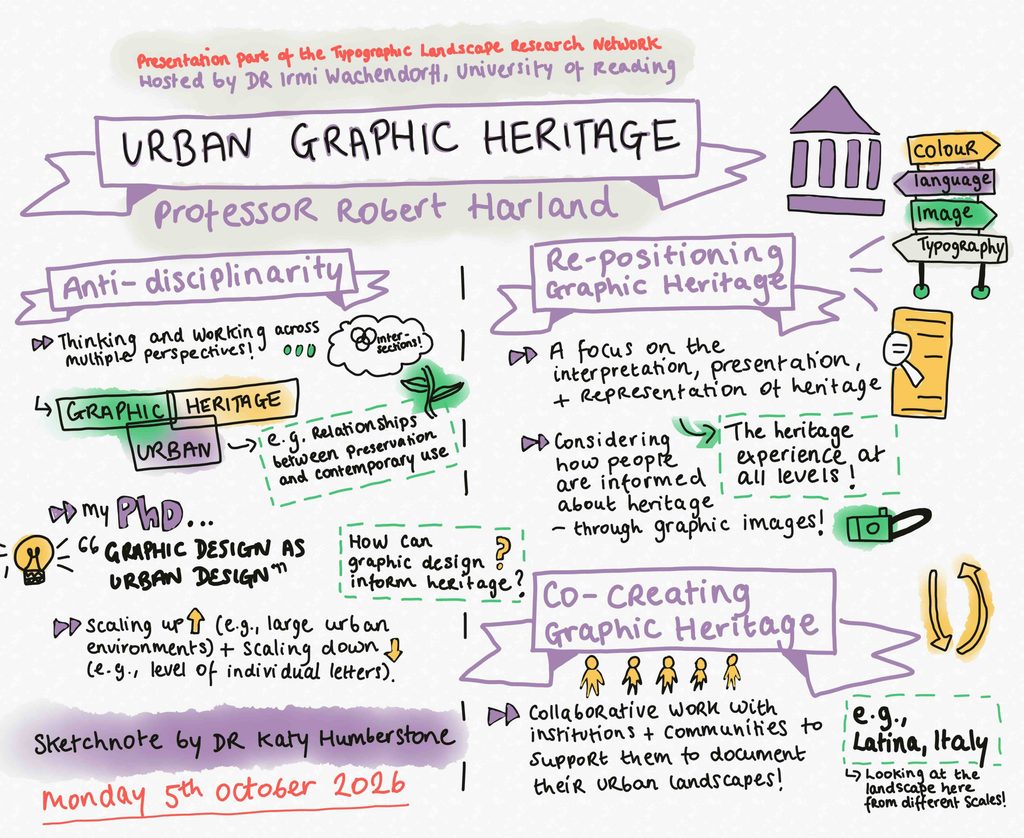
The Typographic Landscape Research Network invited Professor Rob Harland from the School of Design and Creative Arts at Loughborough University to talk about his research exploring Urban Graphic Heritage on Monday 5 October. Typography and town are not usually discussed in the same breath, but this talk spanned the design continuum between them, and featured the creation of the Loughborough TOWN Observatory platform as a vehicle for storytelling as heritage interpretation.

The abstract for the talk read as follows:
What new perspectives can graphic design contribute to design for urban heritage? This talk traces the origin of the question and the development of related research projects spanning several continents over the past decade. It will emphasise an anti-disciplinary approach to establishing the concept of urban graphic heritage and feature photo-documentation as a key research method.
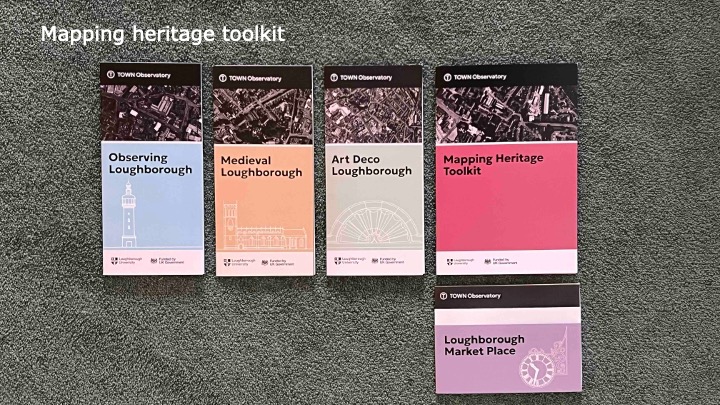
The presentation traced the development of graphic design to graphic heritage, and the scale at which this may be analysed from micrographic, mesographic and macrographic perspectives. In support of this, collaboration with the United Kingdom National Commission for UNESCO regarding the creation of a ‘logical flow’ diagram was highlighted, to enhance the argument for a graphic design perspective on heritage interpretation. Several ‘heritage mapping’ projects were highlighted, with a focus on the Loughborough Art Deco trail. Held online, 34 attended from UK, US, France, India, Sri Lanka, Vietnam, China, Israel, New Zealand and Mexico.
…

…

…
…
…
The Typographic Landscape Research Network is an interdisciplinary forum for researchers interested in typography as social practice in urban space. Convened by Dr Irmi Wachendorff in the Department of Typography & Graphic Communication at the University of Reading, it brings together scholars from typography, sociolinguistics, anthropology and design history to explore how people use letterforms in public space to perform identities, signal belonging, contest power and transform places, looking at all forms of written language from multilingual signage to self-authorised stickers, made by professionals and laypeople alike. Its monthly online seminar series offers a regular space to exchange methods, share work in progress, and think across disciplinary boundaries.
References: Harland, R. G., Bridge, J., Nash, M., & Rabagliati, M. (2024). Utilising Graphic Heritage for Heritage Interpretation: A Case Report on Testing the Applicability of Graphic Heritage as a Development Tool for UNESCO Heritage Designations. Heritage & Society, 17(1), 117–143. https://doi.org/10.1080/2159032X.2023.2248580