Categories
Exploratory project TOWN Observatory

The Para Project: a neighbourhood observatory for South Calcutta

Scheme XVB, Rash Behari Avenue, developed in the 1920s, Source: TBC

The Para Project proposes to develop a living virtual space and a physical exhibit space for photographs, oral narratives, architectural inferences, old documents, and memorabilia of south Kolkata neighbourhoods. The project is ambitious in scope, considering the number and diversity of south Kolkata neighbourhoods in terms of demographics, built heritage, and by extension, people’s history of migration and settlement.

Para Project will provide a robust documentation of urban history, lived spaces and experiences, and architecture of the specific period in early- to mid-twentieth century when the South Kolkata neighbourhoods came into existence and began thriving. This period reflects a very specific time in Kolkata’s modern history and is a living representation of a fast-changing urban landscape that calls for preservation, at least in the form of a ‘memory box’ of digital, physical, and archival material.

The project will focus on two areas.

1: The area bounded by Rash Behari Avenue to the north, S. P. Mukherjee Road to the west, Southern Avenue and Sarat Chatterjee Avenue to the south, and Gariahat Road to the east.

2: The area bounded by Rash Behari Avenue to the north, Kankulia Road to the south, Ballygunge Railway Station to the east, and Gariahat road to the west.

+ + +

Institutional partners

India: The Centre for Studies in Social Science, (CSSSC) and The Jadunath Bhavan Museum & Resource Centre (JBMRC)

United Kingdom: Loughborough University

+ + +

People

India

Mohor Sengupta, PhD, Freelance researcher, writer, and consultant

Tapati Guha-Thakurta, D.Phil., Honourable Professor of History, CSSSC

Rajat Ray, MA, Professor Emeritus, Guru Gobind Singh Indraprastha University, University School of Architecture and Planning

United Kingdom

Robert Harland, PhD, Professor of Urban Graphic Heritage, Loughborough University

Michael Wilson, PhD, Professor of Drama, UNESCO Chair in Storytelling Education for Sustainability, and Director of the Storytelling Academy, Loughborough University

+ + +

The project team examine the deteriorating Art Deco architecture in a South Kolkata neighbourhood in February 2026, stitching together stories that link past and present.

+ + +

Para: a Bengali term for close-knit neighbourhoods.

Categories
Blog TOWN Observatory

From typography to town: the development of Urban Graphic Heritage

The Typographic Landscape Research Network invited Professor Rob Harland from the School of Design and Creative Arts at Loughborough University to talk about his research exploring Urban Graphic Heritage on Monday 5 October. Typography and town are not usually discussed in the same breath, but this talk spanned the design continuum between them, and featured the creation of the Loughborough TOWN Observatory platform as a vehicle for storytelling as heritage interpretation.

Self portrait of the speaker

The abstract for the talk read as follows:

What new perspectives can graphic design contribute to design for urban heritage? This talk traces the origin of the question and the development of related research projects spanning several continents over the past decade. It will emphasise an anti-disciplinary approach to establishing the concept of urban graphic heritage and feature photo-documentation as a key research method.

The presentation traced the development of graphic design to graphic heritage, and the scale at which this may be analysed from micrographic, mesographic and macrographic perspectives. In support of this, collaboration with the United Kingdom National Commission for UNESCO regarding the creation of a ‘logical flow’ diagram was highlighted, to enhance the argument for a graphic design perspective on heritage interpretation. Several ‘heritage mapping’ projects were highlighted, with a focus on the Loughborough Art Deco trail. Held online, 34 attended from UK, US, France, India, Sri Lanka, Vietnam, China, Israel, New Zealand and Mexico.

…

Presentation slide outlining transition from graphic design to graphic heritage, featuring the Blackpool Comedy Carpet analysed at three levels.

…

‘Logical flow’ diagram to support the argument for a graphic design perspective on heritage interpretation. (See Harland et al. 2024)

…

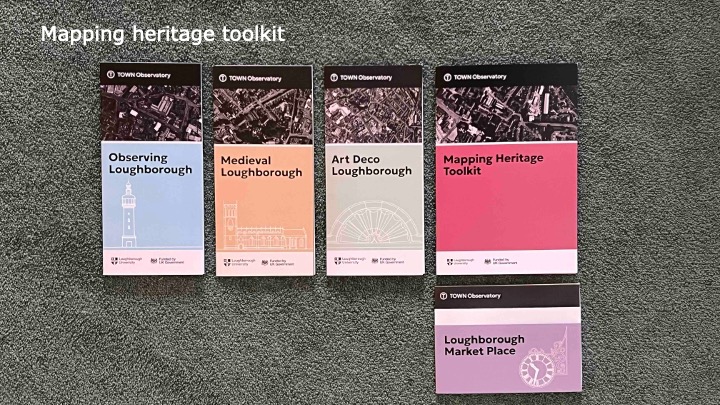
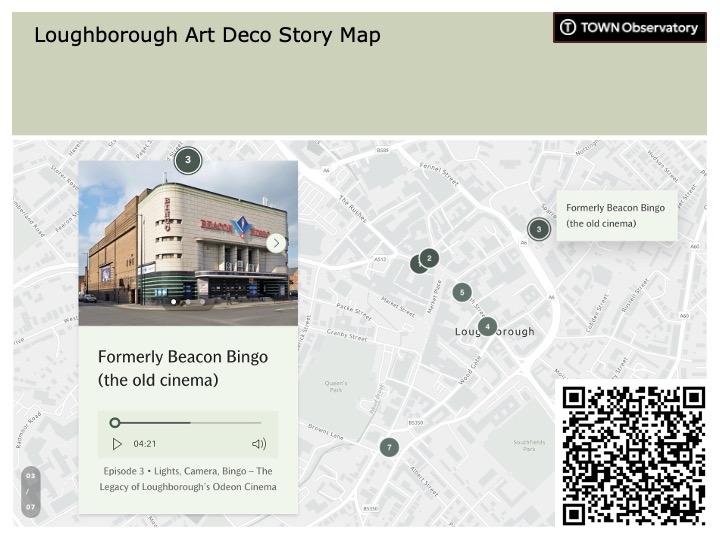
‘Heritage Mapping’ projects created by the TOWN Observatory.

…

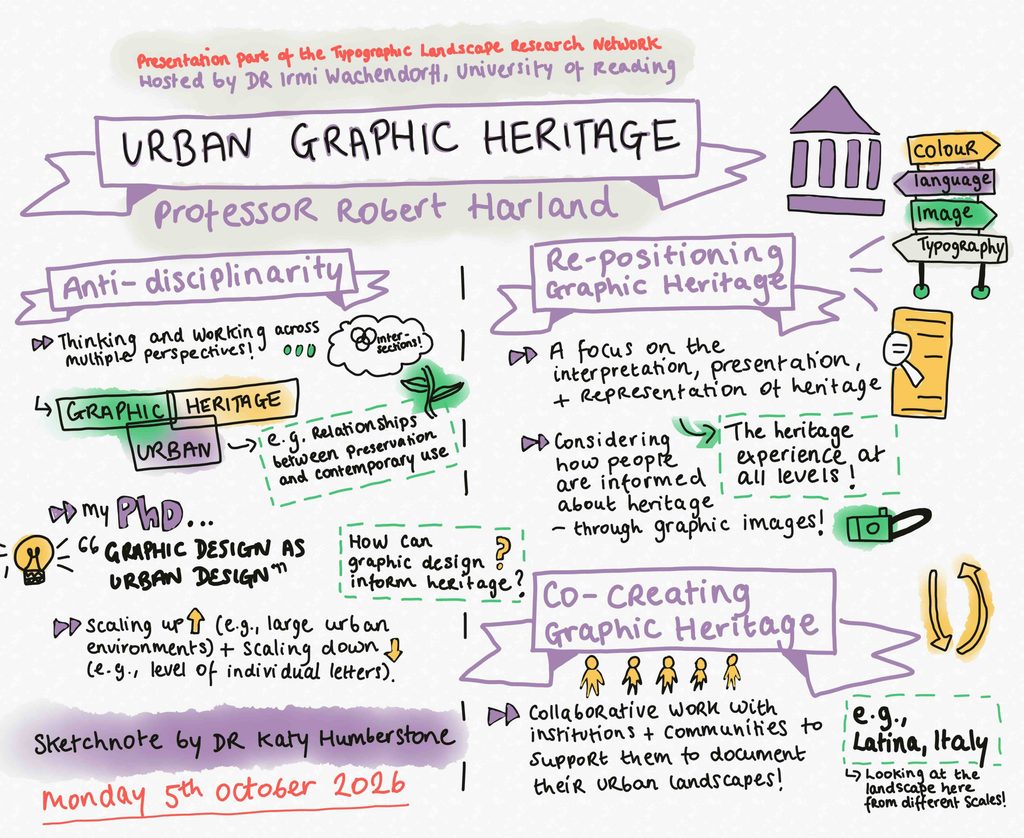
Visual notes by Dr Katy Humberstone who attended the talk

…

The Typographic Landscape Research Network is an interdisciplinary forum for researchers interested in typography as social practice in urban space. Convened by Dr Irmi Wachendorff in the Department of Typography & Graphic Communication at the University of Reading, it brings together scholars from typography, sociolinguistics, anthropology and design history to explore how people use letterforms in public space to perform identities, signal belonging, contest power and transform places, looking at all forms of written language from multilingual signage to self-authorised stickers, made by professionals and laypeople alike. Its monthly online seminar series offers a regular space to exchange methods, share work in progress, and think across disciplinary boundaries.

References: Harland, R. G., Bridge, J., Nash, M., & Rabagliati, M. (2024). Utilising Graphic Heritage for Heritage Interpretation: A Case Report on Testing the Applicability of Graphic Heritage as a Development Tool for UNESCO Heritage Designations. Heritage & Society, 17(1), 117–143. https://doi.org/10.1080/2159032X.2023.2248580

Categories
Blog TOWN Observatory

Promoting careers in the built environment professions

The TOWN Observatory collaborated with the Leicester Urban Observatory to deliver sessions to school pupils about career choices across the built environment professions.

On Tuesday 6 October, 2026, 30 Year Ten pupils from Moat Community College and 12 Year Twelve Geography young people from City of Leicester College enjoyed a morning of walks and talks on urbanism related concepts in Leicester’s cultural quarter.

Sixth form pupils and Head of Geography, John Van Wyk, from City of Leicester College with Dr Robert Harland from Loughborough University in attendance at a session on employment opportunities for built environment professionals.

Ismail Dale, Historic England’s Local Heritage Education Manager for the Heritage Schools Programme provided walking tours of several heritage landmarks, whilst Professor Robert Harland from Loughborough University’s School of Design and Creative Arts provided a talk about career opportunities in the built environment. The sessions were arranged by Justin Webber, Leicester City Council’s Historic Environment Team Leader.

Professional roles in urban design.

Acknowledgements: Special thanks to Chris Slowe, Programme Coordinator at LCB Depot.

The event was organised through collaboration between the Loughborough TOWN Observatory and Leicester Urban Observatory.
Categories
Blog TOWN Observatory

Talk about TOWN

This Loughborough Urban Heritage Doctoral Colloquium brought together four doctoral researchers from Loughborough University’s School of Design and Creative Arts to share their insights into urban heritage. Their research topics are outlined as follows.

Pegah Aftabi (Year three) · ‘Urban heritage’ is a concept used across a variety of fields; yet it extends far beyond expert-defined, monument-centric structures. Urban heritage is a present-centred, continuously evolving phenomenon defined by everyday interactions between communities and their environments. My research adopts a participatory methodology to study urban heritage from the local communities’ perspective in Loughborough. The project ultimately aims to create a digital map of community-centred heritage, not only to preserve heritage but to empower communities to understand their role in, and take greater responsibility for, its preservation.

Greta Chen (Year two) · My research investigates how locative narratives can be co-created to support the understanding, representation and constitution of everyday heritage. Focusing on Loughborough Market as a pilot site, I designed and deployed cultural probes to collect narratives rooted in lived experiences conveying cultural-heritage significance. Analysis identified four themes: spatiality, temporality, sensoriality and social context, which inform a narrative framework for the next stage: an AI-assisted co-design process for locative media and a distributed and inclusive heritage experience in everyday environments to foster community connection.

Sheida Yazdan Joo (Year one) · Leicester’s urban heritage is shaped by migration, cultural diversity and its representation through visual media. My research examines how film and photography construct narratives of the city, drawing on archival materials and contemporary practices. Through analysing the visual contributions of immigrant communities, the study highlights the role of imagery in placemaking, collective memory and the interpretation of Leicester’s evolving cultural landscape. It aims to situate these representations within broader debates on urban identity and heritage.

Alison Mott (Year one) · My practice-based research explores how participatory and co-creative storytelling activities centred on a town’s industrial textile heritage can bring to light overlooked experiences, strengthen the historical record and foster an individual and collective sense of wellbeing. Through oral history collection, creative-writing activities and intergenerational workshops involving older residents and university textile-design students, I examine how personal narratives can be elicited and shared, generating new forms of heritage knowledge and reshaping perceptions of place and the built environment.

Programme

12:00 Arrive

12:10 Welcome

12:15 TOWN Observatory overview

Speakers

12:30 Pegah Aftabi – The local community perspective

12:45 Greta Chen – Everyday heritage

13:00 Alison Mott – Industrial textile heritage

13:15 Sheida Yazdan Joo – Migration and cultural diversity

13:30 Discussion

13:45 End

Categories
Blog TOWN Observatory

Loughborough academics invited to join the UN-Habitat Global Urban Observatory Network Steering Committee

Loughborough University’s recently launched TOWN Observatory has led to two of its leadership team being invited to contribute their expertise to the Steering Committee of the UN-Habitat Global Urban Observatory Network (GUO-Net).

Given the roles they have played in establishing and overseeing the TOWN Observatory, Dr Robert Harland, Reader in Urban Graphic Heritage, will serve as the named committee member, with Dr Taimaz Larimian, Senior Lecturer in Urban Planning, deputising.

Together, they will support the purpose of the Global Urban Observatory Unit, working with a team of Loughborough researchers dedicated to advancing knowledge in this growing field of urban governance.

To learn more about the Global Urban Observatory Network, click here.

Below is the full list of the newly appointed steering committee members:

1. Chairperson, Dr. Carla-Leanne Washbourne: University of Warwick

2. Vice-Chairperson, Mr. Rashid Seedat: Gauteng City-Region Observatory (GCRO)

3. Mr. Dennis Mwaniki: United Nations Human Settlements Programme (UN-HABITAT)

4. Dr. Aref Attia Alshamandy: Qassim Urban Observatory & Egypt Urban Observatory

5. Dr. María Eugenia Goicoechea: Observatorio Urbano Local Buenos Aires Metropolitana (OULBAM)

6. Dr. Karol Janas: Obserwatorium Polityki Miejskiej IRMiR (Urban Policy Observatory IURD)

7. Dr. Dalila Ghodbane: Perspective Brussels

8. Dr. Aseel Almansour: King Abdulaziz University

9. Prof. Nausheen H. Anwar: Karachi Urban Lab (KUL)

10. Eng.Passant Hamza: Egyptian Urban Observatory – Urban Development Fund

11. Mr.Mohamed Alahmri: Royal Commission for Riyadh City – Riyadh Observatory

12. Mr. Saleck Ahmed Cherif: L’Observatoire des Services et du Patrimoine Urbains de Nouakchott (OSPUN)

13. Ms. Gisela Labrador: Metropolitan Region Bogotá – Cundinamarca (Deputy Director)

14. Dr Robert Harland: Loughborough University – TOWN Observatory