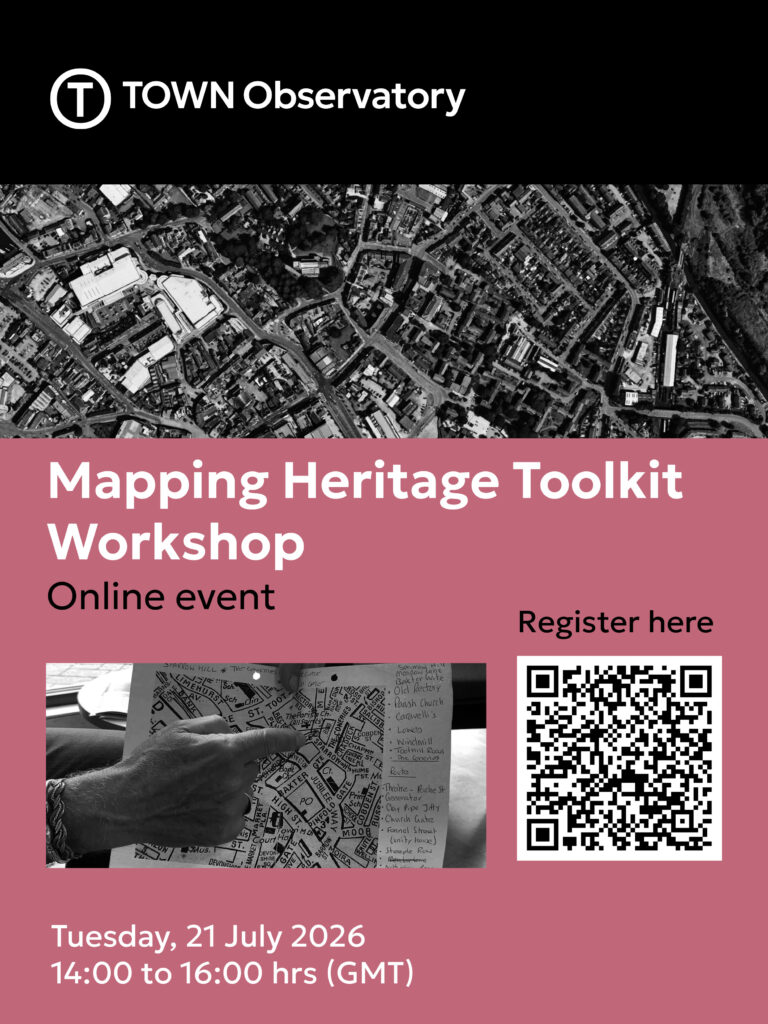
The Mapping Heritage Toolkit Workshop on Tuesday, 21 July, marks the official launch and introduction of the toolkit. If you enjoy local history, lead a community group, or just want to explore how maps and storytelling work together, this toolkit provides a guide through 12 simple steps to co-creating a story map.
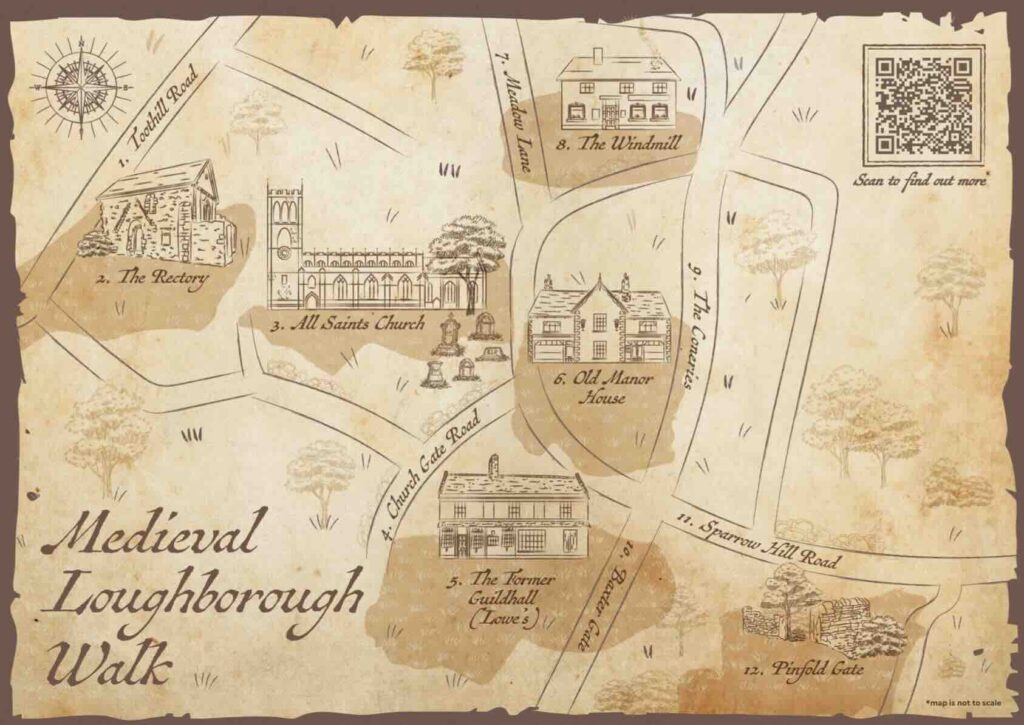
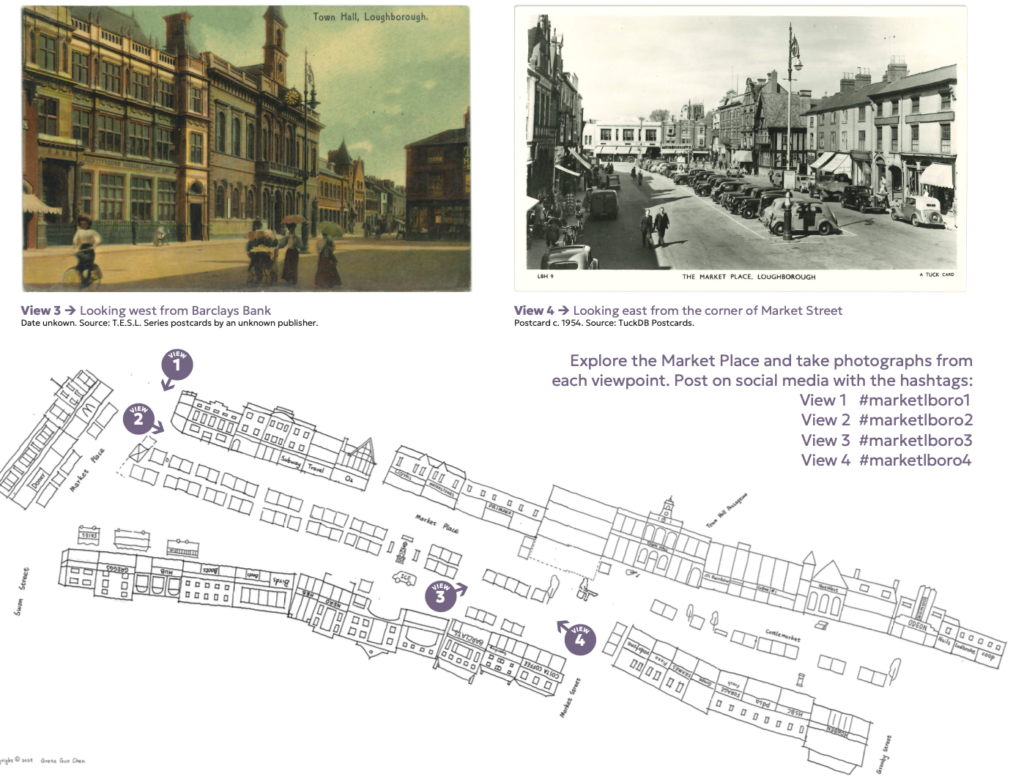
The steps were developed by the TOWN Observatory and the Loughborough Library Local Studies Volunteer Group (LLLSVG), drawing on real experience of collaboration to build a story map from the beginning. Each step includes practical examples from LLLSVG projects concerning the Medieval Loughborough trail, Art Deco trail, and the Market Place, to provide insight into how ideas work in practice.
The toolkit presents a clear structure, providing one approach to creating a story map. Each step highlights key points for consideration in the synthesis of local knowledge, analogue resources, idea development, and creative execution using digital platforms.
For details scan the QR code below or register here.
Organising team Dr Robert G. Harland Dr Cristina A. Goldschmidt Kiminami Pegah Aftabi Greta Chen
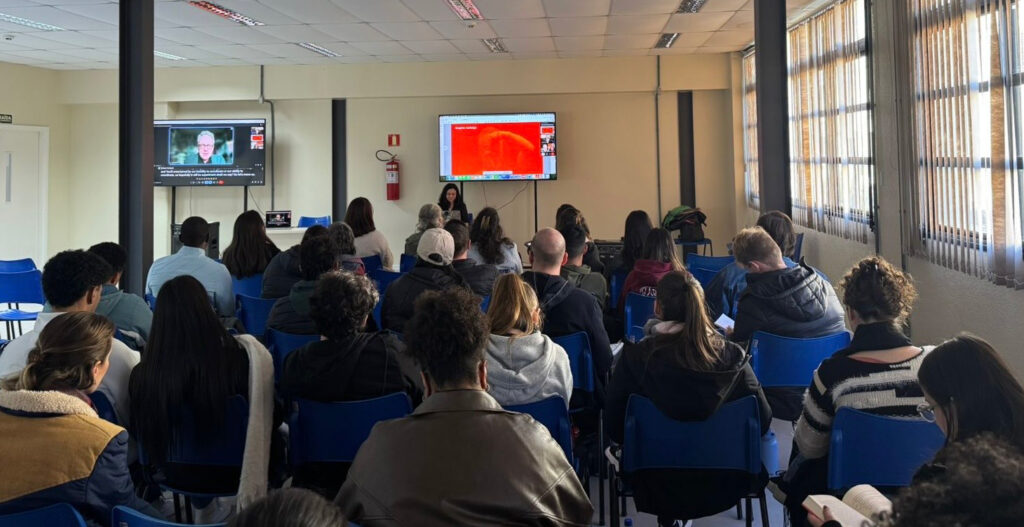
Photo of the hybrid presentation, Dr Robert Harland presenting online from the UK and Dr Cristina Kiminami presenting in person.
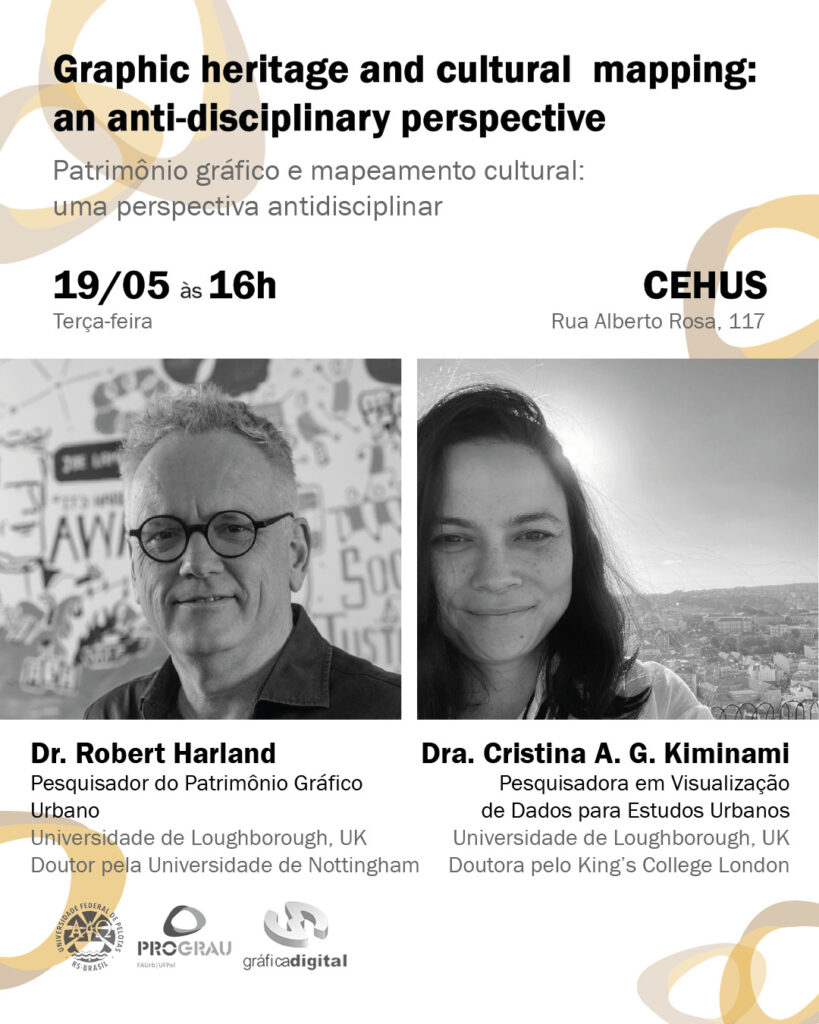
On 19 May, the Federal University of Pelotas in Rio Grande do Sul, Brazil hosted a presentation titled “Graphic Heritage and Cultural Mapping: an Anti-Disciplinary Perspective,” delivered by Dr Robert Harland and Dr Cristina A. G. Kiminami. Organised by the Specialisation Course in Digital Graphics and the Prograu Postgraduate Program in Architecture and Urbanism, the event attracted approximately 50 attendees.
The presentation provided new perspectives on the intersections of graphic heritage and cultural mapping, highlighting the significance of anti-disciplinary approaches in examining these topics. Dr. Harland and Dr. Kiminami facilitated active discussions and promoted the exchange of ideas, contributing to a productive session. They supported their argument by sharing an interpretation of anti-discplinary as:
Good scholarship must involve a tension between ‘discipline’ and ‘anti-discipline’ therefore. My starting point is that one of the most fruitfulways of maintaining this tension is through deep immersion in a discipline, combined with theconstant subjecting of knowledge deriving fromthe discipline to that developed in others (Harriss, 2002).
Participants commended the event for its innovative approach and the opportunity to engage with experts in the field. The presentation was considered successful and demonstrated the TOWN Observatory’s commitment to promoting dialogue and collaboration in digital graphics, heritage studies, and urbanism.
Acknowledgements: with thanks to Dr Tássia Vasconselos, lecturer in Architecture and Urbanism and coordinator of the Specialisation Course in Digital Graphics.
Harriss, J. (2002) ‘The case for cross-disciplinary approaches in international development’, World Development, 30(3), pp. 487–496.
The development of Loughborough’s fabulous Art Deco Trail is the the latest collaboration between researchers at Loughborough University and the Loughborough Library Local Studies Volunteer Group (LLLSVG). The project was shared with members of the Loughborough Heritage Forum on 29 April 2026.
Above: Lougborough’s Art Deco Trail map – Click on the map to download the full leaflet.
Having attended the Forum several times since 2024, the TOWN Observatory was invited to become a permanent member. Chaired by Kathy Phillips, from the Loughborough Library Local Studies Volunteer Group, the Forum meets three times a year. Each in attendance is provided with the opportunity to share their heritage interests and activities, and the meetings are minuted.
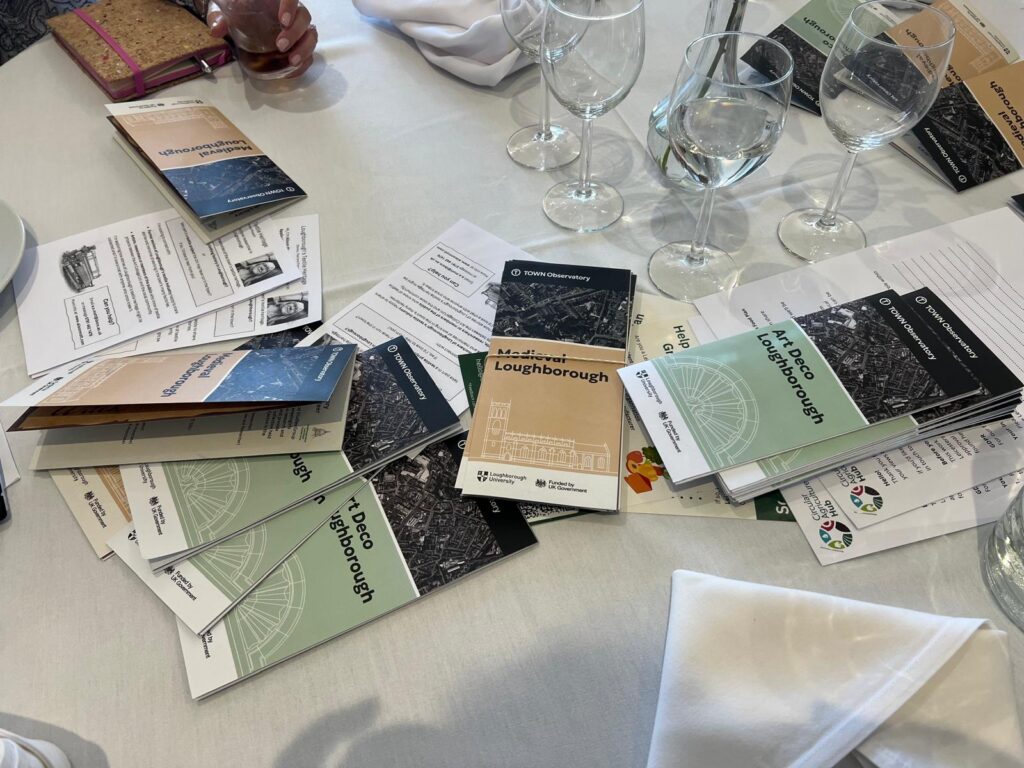
Top: Chairperson Kathy Phillips from LLLSVG introducing the meeting of the Loughborough Heritage Forum. Middle: David Kirkby, and Christine Harris absorbed in discussion about the Art Deco Trail leaflet. Bottom: Leaflets about Art Deco Loughborough and Medieval Loughborough.
Sponsored by the Loughborough Building Society, the Forum provides opportunity to connect regularly with some of Loughborough’s main heritage providers, as well as several independent contributors who bring diverse perspectives. Many attendees are well known to each other.
Loughborough Heritage Forummembers
All Saints with Holy Trinity Loughborough Parish Church
Artspace Loughborough
Beaumanor Hall
Charnwood Arts;
Charnwood Borough Council
Culture Leicestershire
Friends of Charnwood Museum
Friends of Garendon Park
Go Leicestershire
Loughborough Archaeological and Historical Society
Loughborough Building Society
Loughborough Carillon Tower and War Memorial Museum Trust
Loughborough Grammar School
Loughborough Library
Loughborough Library Local Studies Volunteer Group
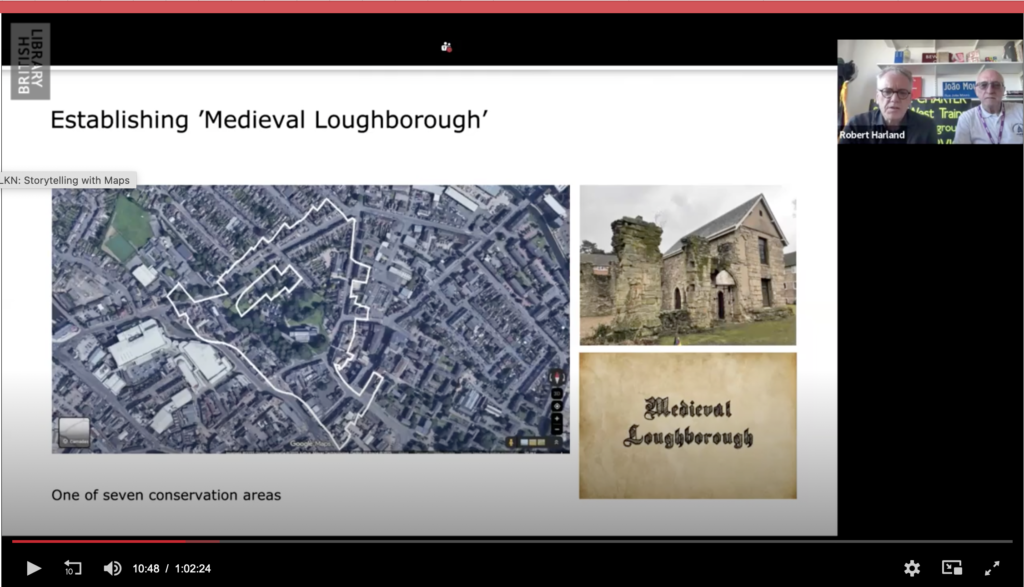
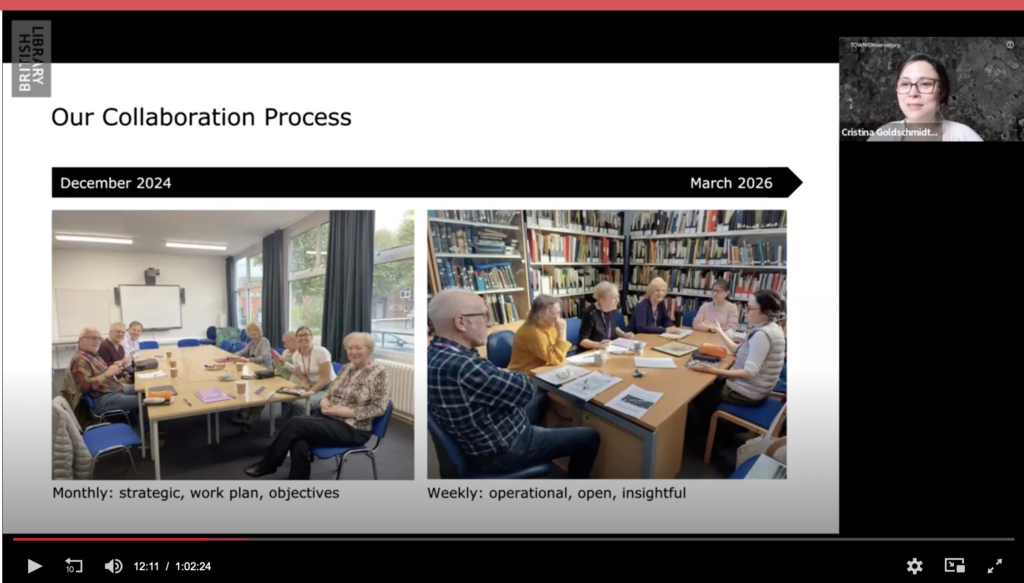
On 18th March, 2026, the Living Knowledge Network – British Library hosted Dr. Cristina Kiminami and Dr. Robert Harland from Loughborough University, who presented their Heritage Mapping project. In collaboration with the Loughborough Library Local Studies Volunteer Group (LLLSVG), the project explored the potential for using the ArcGIS StoryMaps digital platform to combine stories, interactive maps, videos, photos and local history in an engaging experience that makes history easy and accessible for all.
(1)(2)(3)
Images from the webinar, from left to right: (1) Dr Robert Harland introduces the creation of the Medieval Loughborough project; (2) Dr Cristina A. G. Kiminami explains how the collaboration worked, (3) David Kirkby (right) from LLLSVG answering questions from the audience from the volunteer group’s perspective.
This relationship shows how local history and archives can reach more people through open dialogue, co-creation and the development of digital literacy. The webinar shared valuable ideas for local studies librarians, archivists, volunteers and anyone interested in urban heritage, revealing how storytelling and community involvement can bring history to life when universities and local community groups work together.
Watch the full recording of the presentation here.
Acknowledgements: with thanks to Krisztina Lackoi and Zuzzanna Needham for the wonderful opportunity and to David Kirkby for representing the amazing LLLSVG team.
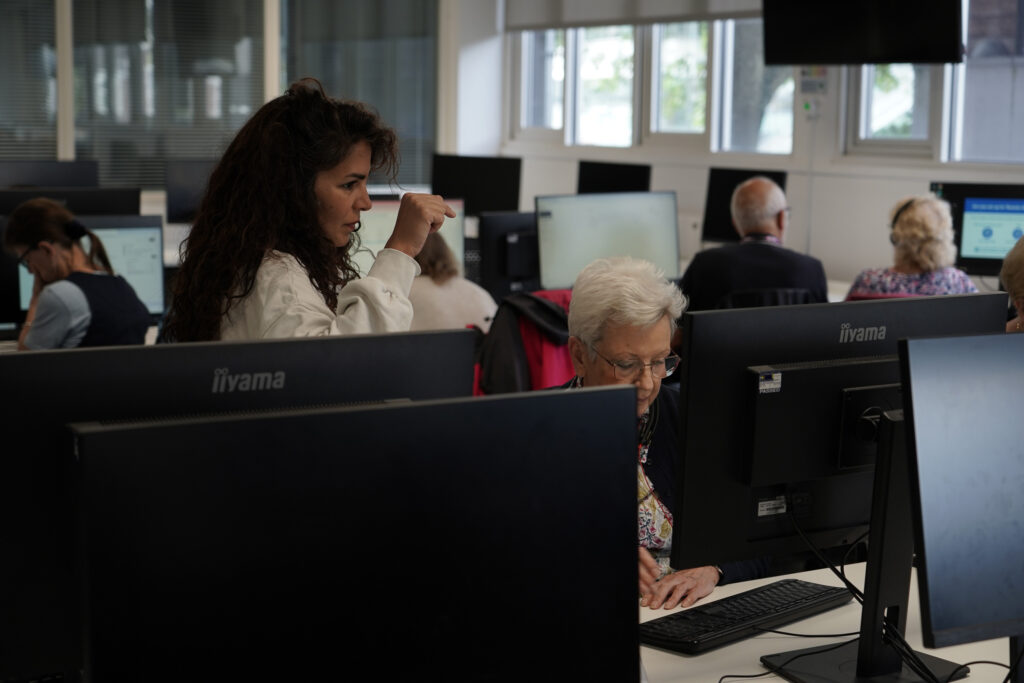
The photo above shows the participants and the instructor, Acka, on the first day of the workshop.
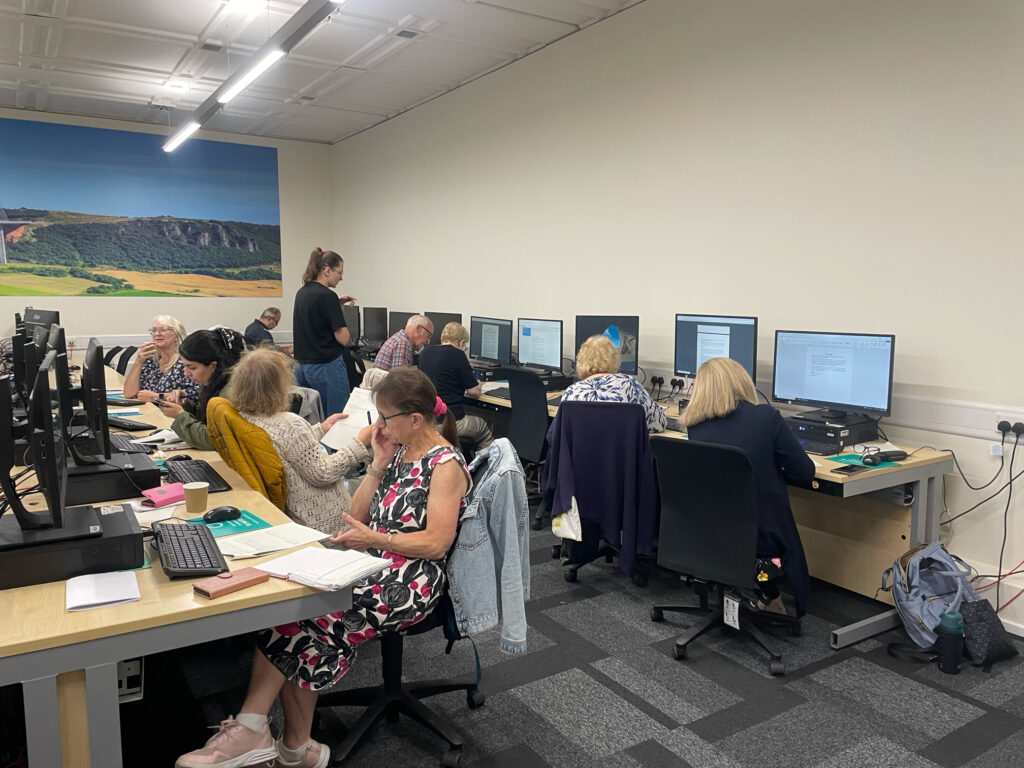
As part of the development of the Heritage Stories Scoping Project, the Loughborough Library Local Studies Volunteer Group (LLLSVG) has shown a keen interest in becoming more autonomous and enhancing their software skills. Inspired by the success of StoryMaps created in collaboration with the TOWN Observatory team, the group expressed a desire to learn new digital storytelling techniques. Recognising this enthusiasm, the TOWN Observatory has actively supported their goals, starting with a tailored 3-session workshop focused on creating AI-generated podcasts and audio stories.
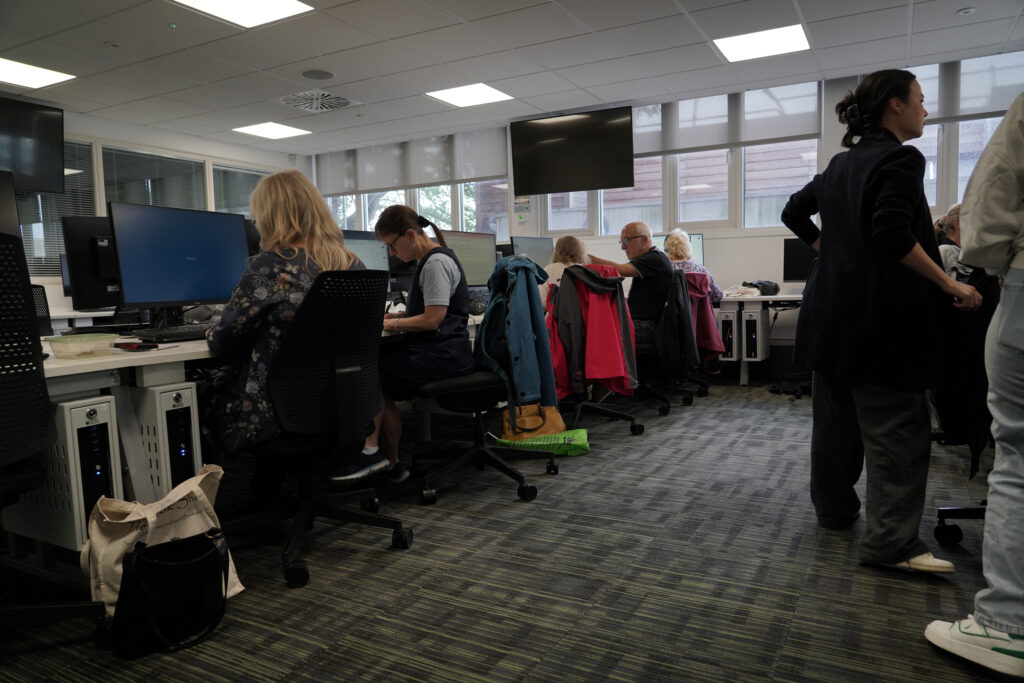
The photo above shows Dr Sara Saravi clarifying questions of one of the participants during the second day of the workshop.
Led by instructor Acka Kruszyc, the workshop brought together 9 participants eager to explore AI-driven storytelling. Over three sessions, they learned how to craft scripts from their own researched and fact-checked texts, and how to use AI voices to bring their stories to life. The involvement of experts, Dr Firat Batmaz and Dr Sara Saravi from the Department of Computer Science added valuable technical guidance, ensuring a comprehensive learning experience. The outcomes of the workshop were highly successful.
(1)(2)(3)
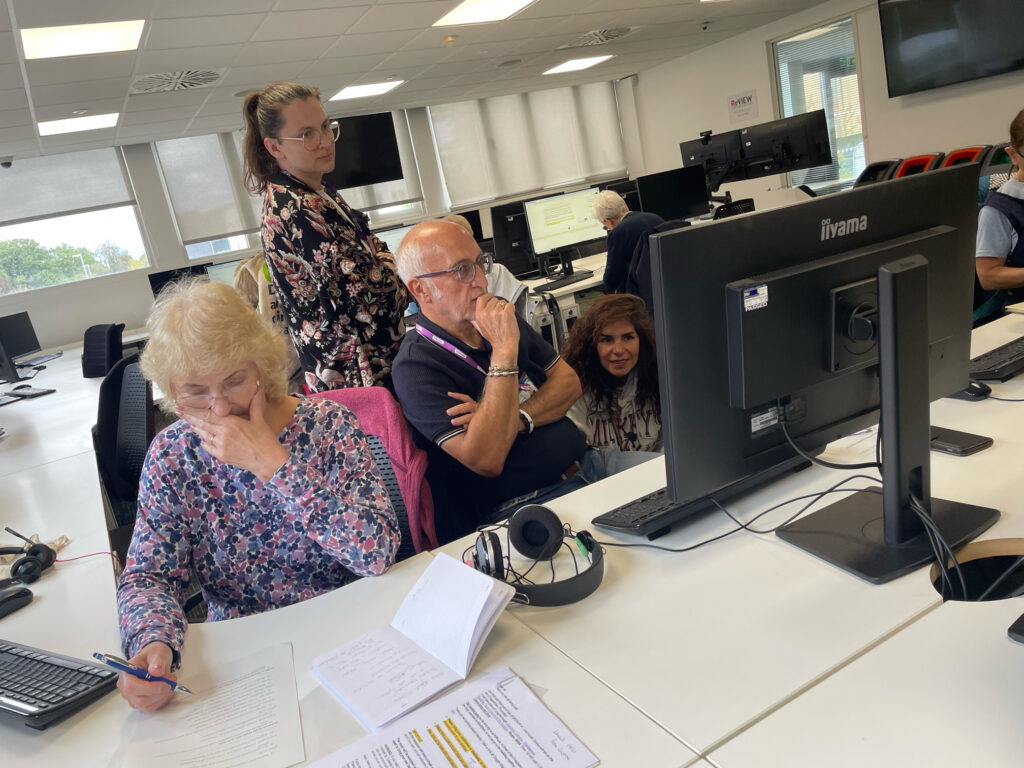
Above (read left to right): (1)Dr Sara Saravi and Acka Kruczyk listening to the audio stories created by a participant. (2) Participants engaging with AI tools to create their audio stories. (3) Participants working on their audio stories with Dr Cristina Goldschmidt Kiminami providing guidance and support throughout the session.
The session concluded participants motivated and excited about the countless possibilities that AI and audio storytelling present for their future projects. This milestone not only equipped the LLLSVG with new skills but also opened the door to innovative ways of engaging their activities through storytelling and digital media.
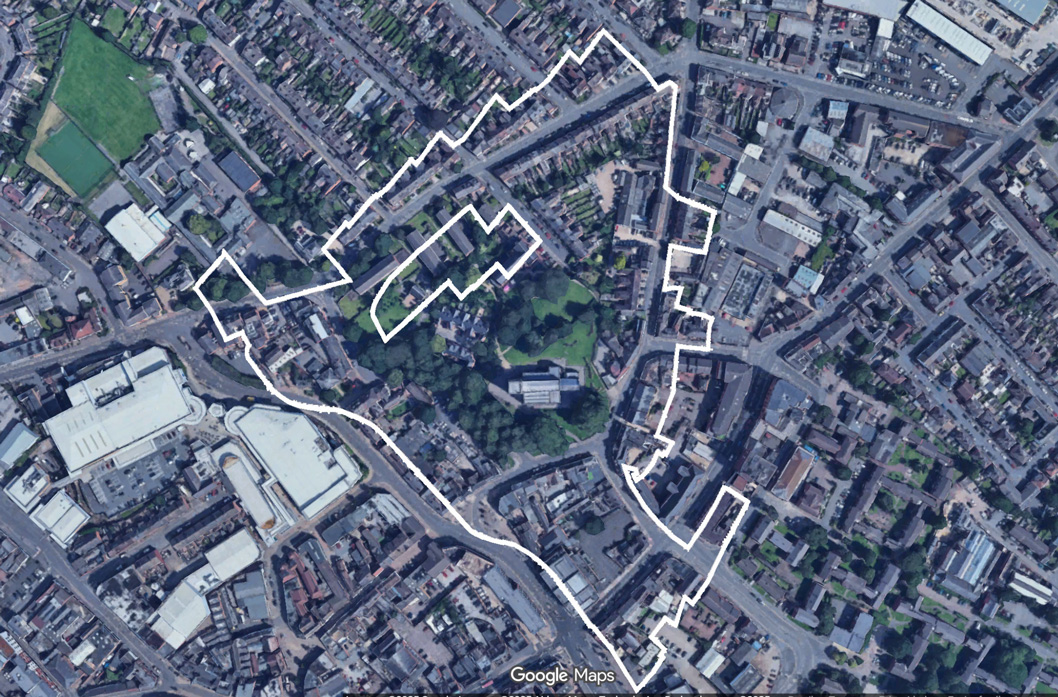
Screenshot of the map from the oldest conservation area of Loughborough. Source: Google Maps outline made by the TO team.
About the project
Heritage mapping is a project with the Loughborough Library Local Studies Volunteer Group (LLLSVG). Known for researching local history, promoting heritage activities in the town, and hosting exhibitions at the Loughborough Library, collaboration with LLLSVG is key to enriching two of the TOWN Observatory platforms: Loughborough Stories and Colouring Loughborough.
For the Colouring Loughborough platform, a team from LLLSVG has uploaded substantial amounts of information, categories, and historical data to the platform. Regarding the Loughborough Stories platform, members of the team have contributed their historical expertise, heritage insights, and lived experiences to create three distinct ArcGIS StoryMaps published on the Loughborough Stories platform.
1. The creation of the Medieval Loughborough Trail
2. StoryMaps and printed materials for Medieval Loughborough Trail, Art Deco Trail and Market Place.
3. Integration of historical building data into the Colouring Loughborough platform.
4. Delivery of an AI and audio storytelling workshop series. LLLSVG members received training in creating AI-generated podcasts, enhancing their skills and engagement.
5. The TOWN Observatory’s participation in the Loughborough Heritage Open Weekend in September 2025, comprising two activities. (i) The TOWN Observatory team gave a series of public presentations, sharing the developments of the initiative across different platforms. (ii) Development and distribution of a information about the TOWN Observatory, and a promotional leaflet (see link below) containing a map to supplement the newly launched Medieval Loughborough Walk organised by the LLLSVG.
6. The TOWN Observatory’s invitation to participate in the Loughborough Heritage Forum by LLLSVG.
From left to right, back row: Yvonne Casswell, John Weightman, Mihyun Kim, Sue Selfe, Lynne Dyer, David Kirkby, Cris G. Kiminami, Kathy Philips, Ian Porter and Nigel Bampton. From left to right, front row: Christine Harris, Sharon Gray, Martin Traynor and Robert Harland.
LLLSVG Project team and roles
Sharon Gray· Team Organiser & Researcher Kathy Phillips · Deputy Team Organiser & Researcher Yvonne Casswell· Researcher Lynne Dyer · Researcher Christine Harris · Researcher David Kirkby · Researcher Sue Selfe · Researcher Nigel Bampton · Photographer
Watch the Art Deco, Medieval Loughborough and Market Place StoryMaps
Download the Medieval Loughborough Trail and Art Deco Trailinformationand maps as A3 folding leaflets
Medieval Loughborough LeafletArt Deco LeafletMarket Place Leaflet
Hear from members of the LLLSVG project team
We walked around Medieval Loughborough and we had three sessions which were totally sold out … and then to give people these leaflets, I should never forget their reaction when a woman said ‘wow, this is fantastic.’ David Kirkby, LLLSVG member
Learn more about the Heritage Mapping project through this Living Knowledge Network webinar for the British Library
The project has begun to deliver wide-ranging impacts. Economically, it has created tourism opportunities and the potential for planned future revenue streams through the Medieval Loughborough trail. Productivity has been enriched as volunteers gained digital skills and streamlined heritage data processes. Cultural impacts included preserving local narratives (via the TOWN Observatory repository) and fostering community pride through innovative StoryMaps and audio stories. Learning and participation expanded through both workshops for LLLSGV and heritage events (e.g. the TOWN Observatory’s involvement in the Heritage Open Weekend), while practitioners gained ethical, co-created resources, which could create a pathway for the potential development of a replicable toolkit for broader application.
Public policy can benefit from data informing urban planning and conservation strategies. There is clear potential for environmental benefits from promoting sustainable tourism via the extremely popular walking tours. Additionally, heritage engagement can lead to improved quality of life and improved mental wellbeing through physical activity and social interaction of the walking tours.
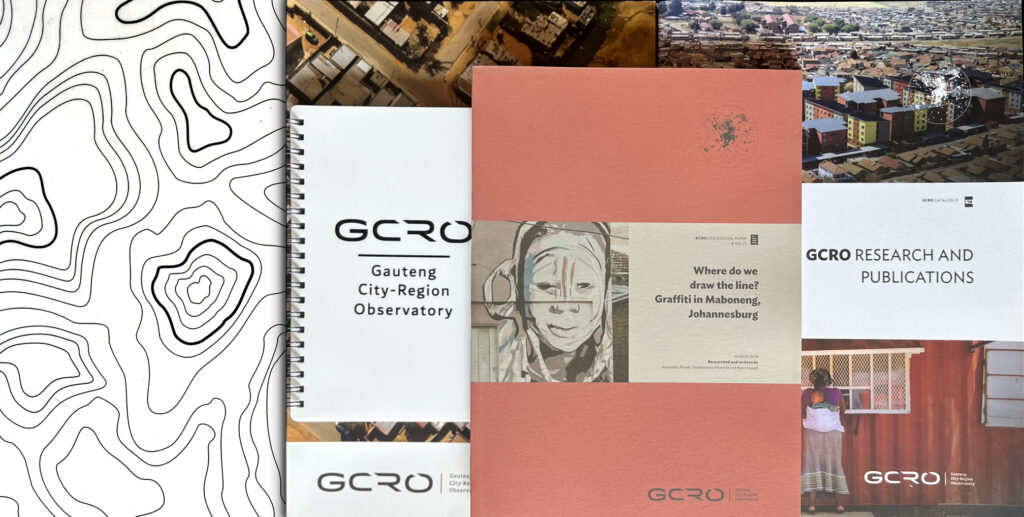
This project is a collaboration between The Impact Hub (TIH) and the Gauteng City-Region Observatory (GCRO) in Johannesburg, South Africa which explores the integration of urban heritage storytelling into digital urban observatories. Urban heritage storytelling is often underrepresented in digital planning tools and urban observatories. This project addresses the gap through international collaboration and knowledge exchange to explore integrating urban heritage data with community storytelling on digital platforms, aiming to influence policy, community engagement, and academic discourse. The initiative builds upon methodologies from the “Named after Nelson” (NaN) project and aligns with UN-Habitat’s Global Urban Observatory Unit’s purpose. The project engages with academics and non-academics, including the UNESCO Chair for Sustainable Storytelling in Education, researchers, policymakers, heritage practitioners and urban residents in South Africa and the United Kingdom.
Activities
Knowledge exchange and international collaboration activities include:
1) Continual dialogue, debates and meetings 2) Online workshop in April 2025 3) In-person visit to Loughborough University by the Senior Manager: Partnerships and Operations of the GCRO in July 2025 4) Roundtable panel discussion hosted by the Institute of Advanced Studies in July 2025 5) Webinar series in February 2026 on urban data & governance, storytelling & community, and AI tools & dashboards (forthcoming) 6) Toponymy map of the Gauteng region (forthcoming)
Impact
Key impacts include the appointment of Dr Yolandi Burger as a Postdoctoral Research Fellow (PDRF) in Urban Graphic Heritage with the GCRO, fostering a new collaboration with the Faculty of Architecture, Design and Art at the University of Johannesburg. Her fellowship also promoted a new research direction at the GCRO exploring urban placemaking and the resulting narratives in these spaces.
Project team and roles
Robert Harland (Lead Investigator) -The Impact Hub, Loughborough University Aline Barata The Impact Hub, Loughborough University Yolandi Burger School of Design and Creative Arts, Loughborough University Rashid Seedat Gauteng City-Region Observatory Thembani Mkhize Gauteng City-Region Observatory Anna Sango Gauteng City-Region Observatory Melinda Swift Gauteng City-Region Observatory Graeme Gotz Gauteng City-Region Observatory
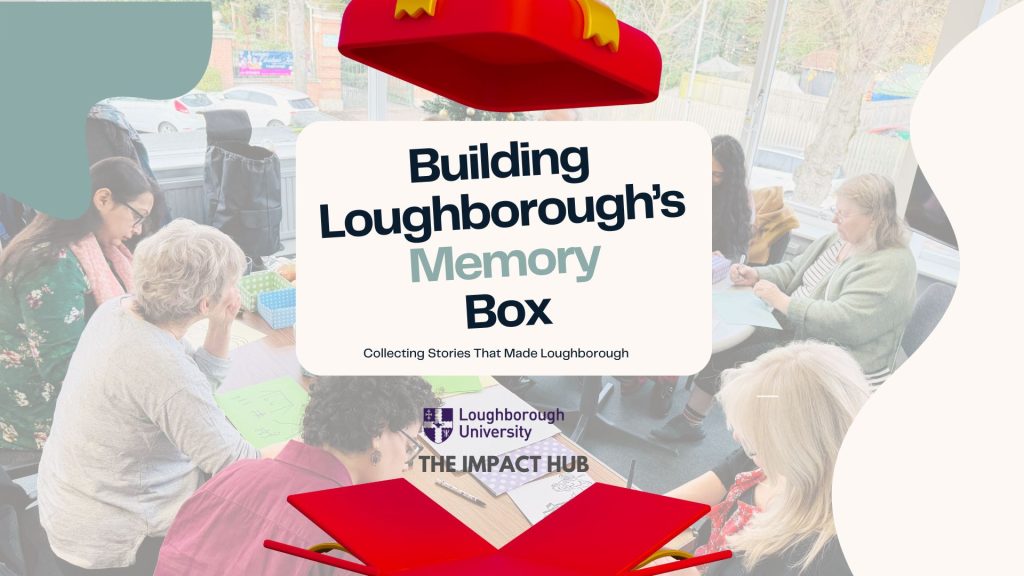
Source: Image created by authors of Building Loughborough Memory Box Project
About the project
The project ‘Building Loughborough’s Memory Box’ sought to gain an understanding of the town’s heritage by asking for opinions from people who call it home. Their experiences of living and working in Loughborough were shared through storytelling and captured by digital means to share again with the wider community.
Alongside their stories, the researchers—Karen and Alison—built a better understanding of what a place’s heritage and culture can be when it truly reflects the lived experiences of those who know it—whether as their home or as a place they come to for work.
Every participant contributed at least one digital story, supported by the researchers in the first set of workshops. Several storytellers then came back together in the second round to create digital stories on their own.
In total, the project worked with 17 people of various ages and demographics, in seven workshops held in a community hub in the centre of town. The result is a collection of digital stories of Loughborough, past and present, that adds to ‘Loughborough’s Memory Box’.
– Community Engagement Workshops Seven workshops at a Loughborough community hub: four on storytelling and illustration, followed by further workshops on creating digital stories. – Story Collection & Digital Archiving Participants shared personal experiences through short audio-visual stories. Researchers also contributed to model the process. – Skill Development & Co-Creation Participants learned basic digital media skills (e.g. video creation, PowerPoint) with researchers as co-participants to encourage collaboration. – Community Building Shared lunches and informal discussions fostered trust, connection, and a sense of value among participants. – Heritage Exploration Storytelling explored diverse meanings of “heritage,” culminating in a collated digital archive in the form of the “Building Loughborough’s Memory Box” StoryMap on the Loughborough Stories Platform of the TOWN Observatory.
Impact summary
The Building Loughborough’s Memory Box project has created meaningful change across several dimensions. It fostered strong social connections, bringing together students and long-term residents, breaking down barriers between local and academic communities, and reducing isolation through shared activities and communal lunches. Participants felt validated and heard, with their stories now forming part of Loughborough’s cultural record, reinforcing a sense of belonging and purpose. On a personal level, the initiative led to increased confidence and empowerment, inspiring creative pursuits, new skills, and opportunities for academic and personal growth as reported by both participants and researchers. It also enabled skill development in digital storytelling and visual illustration, helping participants share their narratives effectively. Culturally, the project achieved heritage preservation, creating an archive of 27 digital stories that offer diverse perspectives and contribute to the Loughborough TOWN Observatory as a shared resource, while broadening the definition of heritage to include everyday lived experiences. Finally, the project delivered educational and research impact by modelling participatory approaches that reduce hierarchy, promote authentic engagement, and establish strategies to overcome challenges such as technology access and time constraints. These efforts lay the foundation for best practices in community-based research, and it is hoped they will inspire future initiatives to embrace participatory storytelling and expand the growing collection of community narratives.